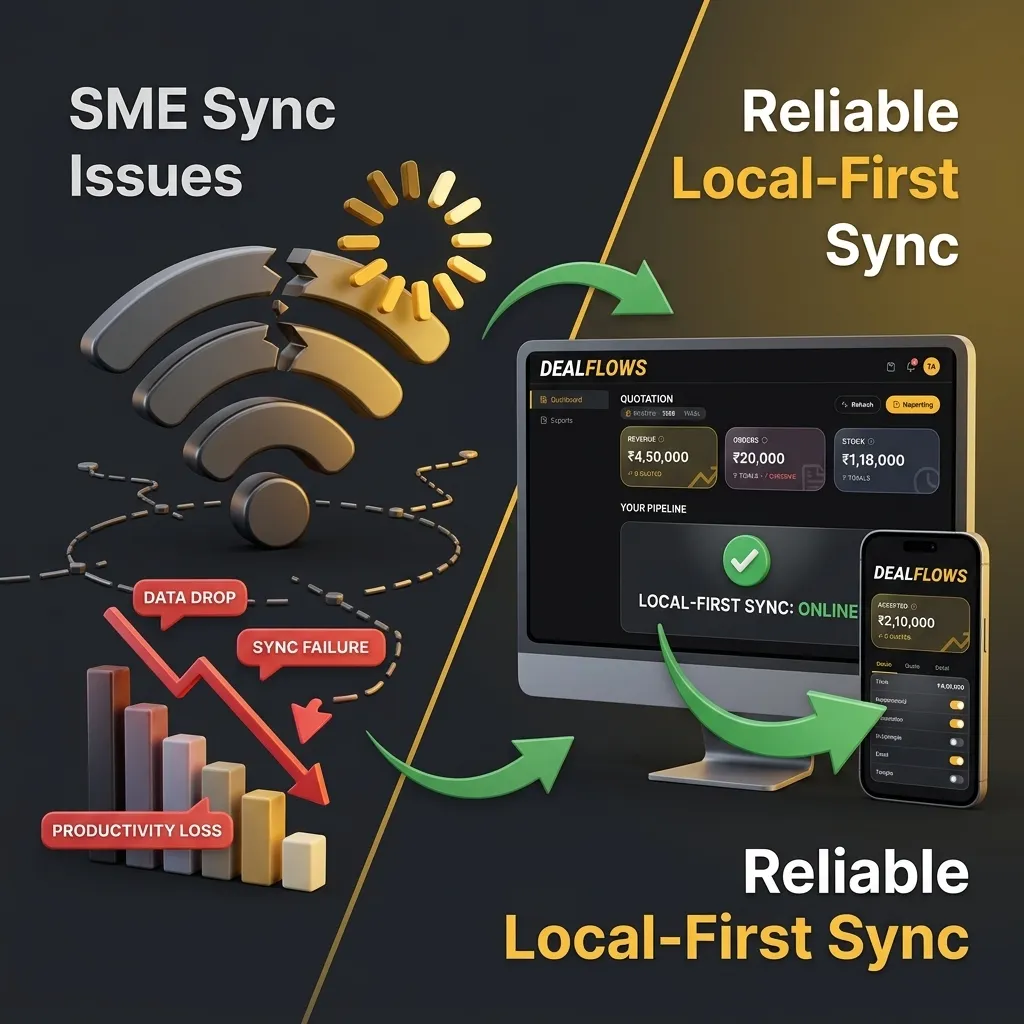

We've all been there: You enter an order, update your inventory, or add a new lead — and then the "Sync Failed" spinner appears. You refresh. You wait. You re-enter the data and hope it didn't duplicate.
In India, where 4G speeds average 23 Mbps but drop to near-zero in warehouses, construction sites, and tier-2 markets, sync failures aren't edge cases. They're Tuesday.
The Tools SMEs Trust Are Built for Better Internet Than India Has
The three most common SME software stacks in India — Zoho Books, Tally Prime with cloud extensions, and Vyapar — all have documented, recurring sync complaints. A quick scan of their app store reviews tells the story:
- Zoho Books has hundreds of reviews on the Google Play Store citing "data not syncing," "invoice disappeared after reconnect," and "offline mode doesn't work as advertised." Zoho's own support forum has open threads dating back to 2021 on GSTR-2B sync failures that persist through connectivity drops.
- Tally Prime's cloud sync (TallyPrime with TallyPrime Server) has a well-known limitation: it requires a persistent connection to the Tally server. If your shop's broadband hiccups, the session simply drops. Tally's architecture was designed in an era when "going online" meant a dedicated desktop — not a field sales rep on a BSNL connection in Nashik.
- Vyapar, despite being mobile-first and widely used by kirana and trading businesses, routes all multi-device sync through its cloud. Users in low-connectivity areas frequently report that the app silently fails to push local changes — meaning two devices can hold conflicting versions of the same invoice with no warning.
These aren't bugs that will get patched. They're architectural decisions that are expensive to undo.
The True Cost of Sync Failures
The Indian B2B e-commerce and SME software market is projected to cross $100 billion by 2027, yet the foundational reliability problem remains largely unsolved. Here's what that costs at ground level:
- Inventory Discrepancy: You sell an item that's already out of stock because the warehouse device and the counter device diverged during a 40-second connectivity gap. The customer is disappointed; you're issuing a refund and paying the return logistics.
- Lost Leads: A field sales rep logs a hot inquiry at a client site with poor signal. The app queues it locally — but the queue silently fails to flush. By the time the rep is back in the office and the duplicate entry is spotted, the follow-up window has closed.
- Invoicing Errors: Stale pricing data gets baked into a sent invoice. The correction requires a credit note, a revised invoice, a follow-up email, and 45 minutes of someone's time — for a problem that should never have existed.
- GST Filing Cascades: A sync failure that corrupts an invoice record doesn't just create a client problem. It creates a GSTR-1 discrepancy, which flows into your buyer's GSTR-2B mismatch, which can trigger a Section 61 notice. One dropped packet becomes a compliance fire.
A 2023 NASSCOM report on SME digitization found that data entry errors and reconciliation failures — most traceable to sync and connectivity problems — cost Indian SMEs an estimated ₹22,000 crore annually in lost productivity and penalty exposure.
Why "Offline-First" is the Next Competitive Moat
Most SaaS tools are built on a "Cloud-Always" philosophy because it's cheaper to build. Storing data locally, handling conflict resolution, and building a robust sync queue requires significantly more engineering investment than simply requiring a live connection and throwing an error when it's absent.
The architecture that gets this right is called Local-First: your data lives on the device first, syncs to the cloud second. The application is fully functional with zero connectivity. When the connection returns, a deterministic conflict-resolution engine merges changes across devices without data loss.
This isn't theoretical. It's how Linear (the project management tool beloved by engineering teams) was built, and it's a core reason their retention metrics outperform cloud-only competitors. The same principle applies to SME finance tools — arguably with higher stakes, since financial data corruption has legal consequences that a missed task does not.
At DealFlows, we built our sync engine on this foundation:
- Bulletproof Reliability: Work from a warehouse, a rural construction site, or a crowded trade fair stall. Every action is written to local storage instantly — the cloud is a sync target, not a dependency.
- Conflict-Free Atomic Syncing: When you reconnect, the engine replays your local operation log against the server state using a last-write-wins strategy with field-level granularity — not row-level overwrites that clobber concurrent edits.
- Visible Sync Status: You always know what's local, what's synced, and what's pending. No silent failures. No hope-it-worked moments.
The Bottom Line
If your current software requires a stable internet connection to function reliably, you are not using a business tool — you are using a liability that charges you a monthly subscription.
Indian SMEs operate in the real world: patchy 4G, shared WiFi, mobile-first teams spread across geographies. Your software should be built for that world, not for a San Francisco co-working space with gigabit fiber.
Stop donating your leads, your inventory accuracy, and your GST compliance to unstable sync architecture. Start on a foundation that works.
Tired of 'Sync Failed' Spinners?
Build your business on a local-first foundation that works even when the internet doesn't. Start with DealFlows today.
START FREE TRIAL 🚀No credit card required • Set up in 2 minutes