
THE SHORT ANSWER
Modern Interior Design BOQ Management: Interior designers in India lose 15 to 20 billable hours per project recalculating 60-row Excel spreadsheets across multiple finish options: laminate, acrylic, and PU polish. By adopting dedicated interior design boq quotation software india, studios organize estimates by room zones with standardized unit measurements (Sq. Ft., Rft.), attach visual material swatches, and allow clients to toggle finishes in a live digital link. This structure eliminates quote revision fatigue, prevents client price shopping in wholesale markets, and cuts approval timelines from two weeks to under 48 hours.
You just spent four consecutive nights after site visits drafting a 65-row Bill of Quantities (BOQ) in Excel for a ₹14 Lakh 3BHK flat in HSR Layout, Bangalore. You meticulously calculated every single hinge, BWP 710 marine ply carcass, Merino laminate sheet, and false ceiling running foot.
You export the spreadsheet as a multi-page PDF and send it over WhatsApp.
Two hours later, your phone buzzes with a voice note from the client: "Hi, we love the overall concept, but can you send three revised quotes? We want acrylic for the kitchen, matte laminate for the kids room, no false ceiling in the dining area, and please show what it costs with and without Hafele soft-close drawers."
Your heart sinks. That single WhatsApp text just wiped out your entire weekend.
The 60-Row Excel Trap That Paralyzes Client Decisions
Most residential and commercial interior designers in India still run their design practices on Microsoft Excel or Google Sheets. While spreadsheets are flexible, they were never designed to be client-facing sales documents.
When you send a 60-row static PDF to a homeowner, this is what happens behind the scenes:
- Option paralysis: Homeowners cannot visualize how material selections affect their total budget. When confronted with rows of hardware codes and raw square foot rates, they freeze.
- Formula corruption: One misplaced cell reference in an Excel template can cause you to underquote carpentry labour by ₹75,000, eating into your design margins.
- The version control nightmare: Your desktop folder fills up with files named
Sharma_Residence_Quote_v1.pdf,Sharma_Quote_v2_acrylic.pdf, andSharma_FINAL_revised_v4.pdf. Nobody knows which version contains the agreed scope.
Every time you send a static PDF quote with multiple options, you transfer the cognitive burden to the client. When clients feel overwhelmed by a wall of raw numbers, they do not make decisions: they stall.
Why PDF BOQs Invite Destructive Price-Shopping
There is an even deeper commercial risk with sending static PDF BOQs in the Indian market: premature price shopping.
When you hand over an itemized PDF listing every single hardware model number, plywood brand, and paint code, you hand over your intellectual property. Many clients take that exact document to wholesale timber markets: like Chickpet in Bangalore, Lohar Chawl in Mumbai, or Kirti Nagar in Delhi: to cross-verify rates against independent local contractors.
These local contractors often claim they can execute your designs for 25% less by cutting corners on internal adhesives or using commercial ply instead of certified boiling water-proof (BWP) boards. Because your PDF only shows numbers and specifications, you end up competing on raw material costs rather than design value.
The Fix: Interior studios must shift from raw material item lists to room-wise conceptual scopes. By presenting proposals organized by zones: Foyer, Living, Modular Kitchen, and Master Suite: with interactive finish tiers, you protect your design authority and present an integrated design-build service rather than a grocery receipt.
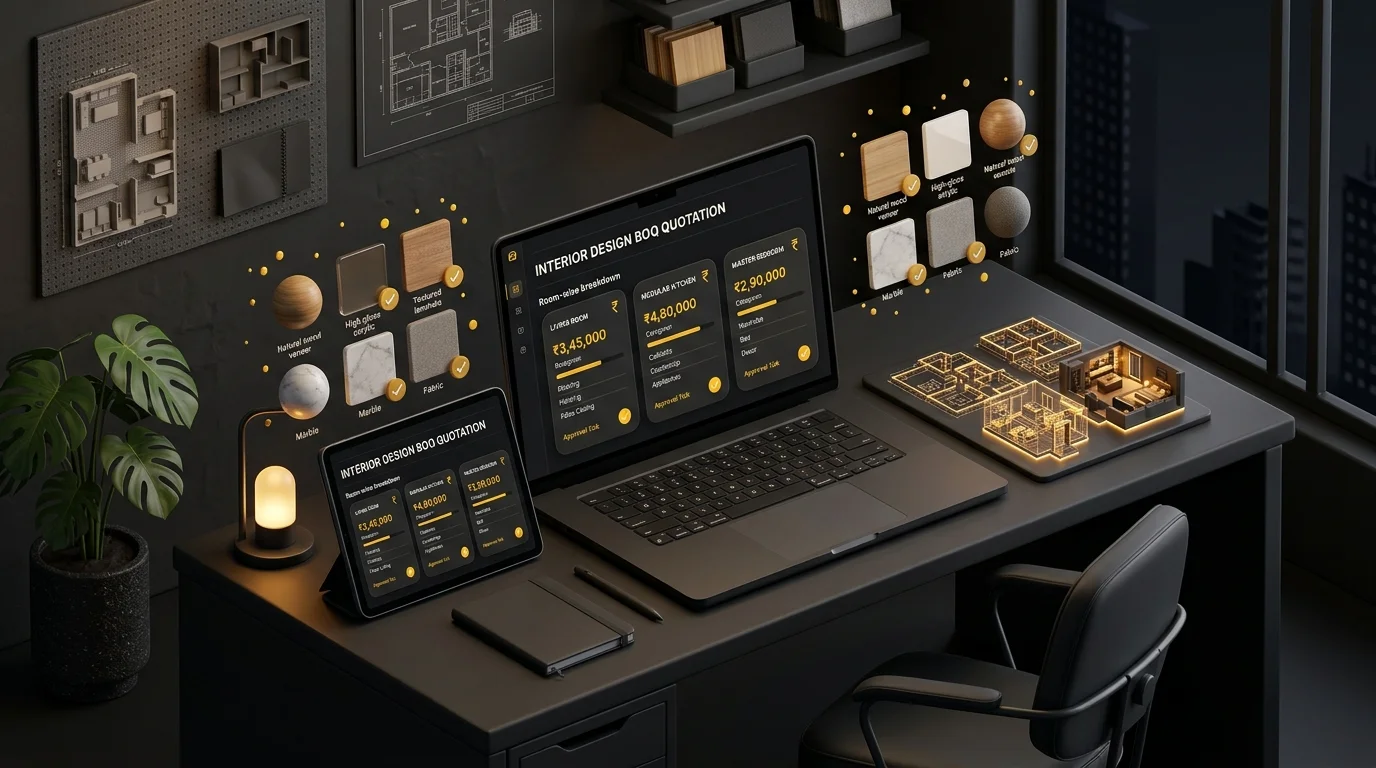
The DealFlows Solution: DealFlows replaces static spreadsheets with an interactive quotation portal structured around room zones. Clients explore clean room-by-room totals with customizable finish tiers, letting them customize options without exposing your back-end trade discounts to the local market.
Why Indian Studios Need Interior Design BOQ Quotation Software
To scale an interior studio beyond 3 to 4 concurrent projects in India, designers need purpose-built tools that match local renovation realities. Unlike static PDF quotations that force days of revision emails, interactive portals allow homeowners to make trade-offs within their budget in minutes.
A modern interior estimation portal provides three structural capabilities:
- Room-Wise Hierarchies with Indian UOMs: Organizes estimates strictly by room (Foyer, Kitchen, Master Bedroom) with built-in Units of Measurement (Sq. Ft., Rft., Nos., Lumpsum) and dimension calculators (Length × Height).
- Visual Material Swatches: Instead of deciphering technical lines like "1mm High Gloss Laminate vs 1.5mm Anti-Scratch Acrylic", clients click visual cards displaying high-resolution texture swatches and 3D render previews.
- Real-Time Client Scope Toggles: Clients toggle optional add-ons directly in the link: such as an arched fluted panel in the dining foyer for +₹28,000: and watch the total update instantly, eliminating scope ambiguity before site work starts. Pairing this with interior design scope creep billing ensures revisions are locked in writing.
When clients toggle upgrades themselves, psychological ownership shifts. They do not feel like you are upselling them: they feel in complete control of their dream home.
Indian interior studios using interactive quotation portals report reducing quote approval cycles from 18 days to under 48 hours, while capturing an average 18% higher project value through self-selected finish upgrades.
Unlocking High-Ticket Milestone Payments Beyond the UPI Cap
Securing quotation approval is only half the battle. In Indian interior design, turnkey projects typically range from ₹8 Lakh to ₹35 Lakh, with milestone disbursements split across stages:
- Stage 1: 10% Booking advance
- Stage 2: 40% Factory sign-off and plywood delivery to site
- Stage 3: 30% Carpentry carcass completion and painting prep
- Stage 4: 10% Countertops, glass, and electrical fittings
- Stage 5: 10% Final handover and snag list clearance
Because single milestone invoices regularly exceed ₹1,00,000, standard UPI limits frequently fail. Designers are forced to paste bank account numbers into WhatsApp chats, leaving payments stranded while waiting for NEFT confirmations and screenshot proof.
The DealFlows Solution: DealFlows integrates intelligent dual payment rails directly into the quotation portal. For booking advances under ₹1 Lakh, clients scan a zero-commission UPI QR code on their phone in 10 seconds. For high-ticket milestones above ₹1 Lakh, the portal presents studio RTGS/NEFT coordinates alongside an integrated 12-digit UTR verification screen. Designers verify the bank transfer in one click, instantly auto-generating a GST-compliant advance receipt and keeping the project on schedule.
Key Takeaways
Modernizing your quote presentation transforms how clients perceive your interior design studio:
- Ditch the 50-row Excel spreadsheet: Group quotations by room zones with clear unit measurements so homeowners understand the scope at a glance.
- Empower clients with visual finish toggles: Allow clients to select between laminate, acrylic, and veneer options in real time, turning stressful price negotiations into collaborative design choices.
- Bridge scope lock to milestone payments: Remove payment friction by coupling instant digital sign-offs with direct UPI and verified NEFT payment workflows.
Presenting your interior designs through an interactive command center elevates your studio above budget contractors and secures commitments before the weekend ends.
Tired of Spending Nights in Excel BOQs?
Join 500+ Indian interior designers and studios using DealFlows to turn 50-page spreadsheets into interactive, room-wise approval portals.
START FREE TRIAL 🚀No credit card required • Set up in 2 minutes